


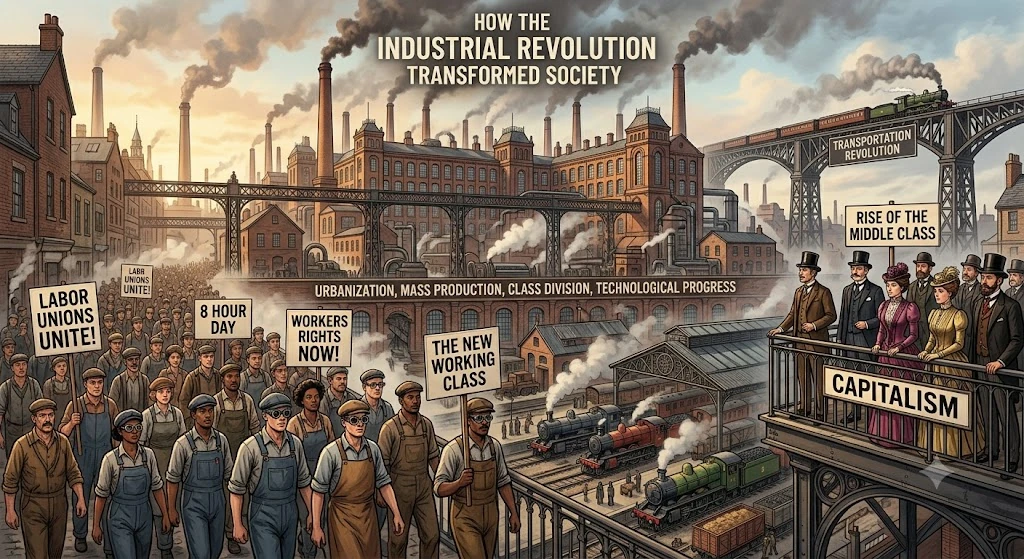
The Industrial Revolution was one of the most significant periods of change in human history. Beginning in Britain during the late 18th century and spreading to Europe, North America, and other parts of the world, it transformed how people worked, lived, traveled, and communicated. The shift from hand production to machines and factories created new economic opportunities, but it also introduced serious social and environmental challenges. Its effects continue to influence modern society today.
The Rise of Factories and Mass Production
Before the Industrial Revolution, most products were made by skilled workers in homes or small workshops. Production was generally slow and depended heavily on human and animal labor. The development of machines powered by water and steam changed this system dramatically.
Factories allowed large numbers of workers and machines to operate in one location. New inventions, including improved steam engines and mechanical textile equipment, increased production and reduced the time required to manufacture goods. Mass production eventually made many products more affordable and accessible to ordinary people.
Urbanization and Changing Communities
One of the most visible effects of industrialization was rapid urbanization. Factories were usually established in or around towns, attracting workers from rural areas. People moved to cities in search of employment and better economic opportunities.
As cities expanded, new neighborhoods, transportation systems, markets, and public services developed. However, urban growth was often faster than infrastructure development. Many industrial cities experienced overcrowded housing, poor sanitation, pollution, and inadequate access to clean water. These conditions eventually encouraged governments to introduce public health and urban improvement programs.
Changes in the Workforce
Industrialization completely changed the nature of employment. Factory work offered regular wages, but working conditions were often difficult. Employees could work long hours in noisy, dangerous environments, while workplace safety regulations were limited.
Women and children were also employed in many factories and mines because employers could often pay them less than adult male workers. Over time, public concern about working conditions led to labor reforms, restrictions on child labor, shorter working hours, and improved workplace protections.
The growth of factories also contributed to the development of organized labor. Workers began forming trade unions and demanding better wages, safer conditions, and reasonable working hours. These movements played an important role in shaping modern labor rights.
Economic Growth and the Middle Class
The Industrial Revolution generated enormous economic growth. Factory owners, entrepreneurs, merchants, engineers, and professionals benefited from expanding industries and markets. A larger middle class emerged, changing traditional social structures.
Banking, finance, transportation, and international trade also expanded. Railways and steamships allowed goods and people to travel farther and faster than before. This helped businesses reach new markets and encouraged international economic connections.
Improvements in Transportation and Communication
Industrialization revolutionized transportation. Steam-powered trains and ships dramatically reduced travel times and made long-distance trade more efficient. Railways connected cities and industrial centers, allowing raw materials to reach factories and finished products to reach consumers.
Communication also improved during this period. The development of the telegraph allowed information to travel across long distances much faster than traditional mail systems. These advances helped businesses, governments, and individuals communicate more efficiently.
Social and Environmental Consequences
Although industrialization brought progress, it also created significant problems. Factory emissions and coal consumption contributed to air pollution, while industrial waste contaminated rivers and surrounding areas. Rapid urbanization placed additional pressure on natural resources.
The enormous demand for coal, iron, cotton, and other raw materials also encouraged extensive mining and resource extraction. These environmental consequences became increasingly important as industrial economies expanded.
A Lasting Legacy
The Industrial Revolution changed society on an unprecedented scale. It encouraged technological innovation, economic growth, urban development, and new forms of employment. At the same time, it exposed serious inequalities and workplace problems that inspired social reform.
Modern manufacturing, transportation, cities, and many aspects of employment can be traced back to this transformative period. Most importantly, the Industrial Revolution demonstrated how technology can reshape society—not only by creating new opportunities but also by creating challenges that require thoughtful solutions. Its legacy remains visible in the modern industrial and technological world.


Leave a Reply