


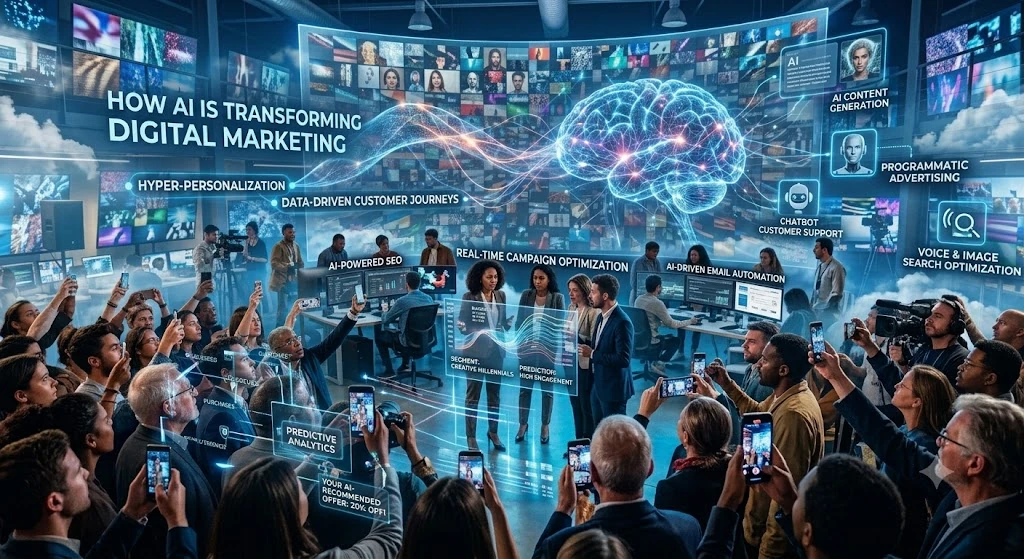
Artificial intelligence (AI) is rapidly changing digital marketing by helping businesses understand customers, create content, automate tasks, and make better decisions. From personalized recommendations to intelligent chatbots and predictive analytics, AI allows marketers to work more efficiently while delivering more relevant experiences. As technology continues to develop, AI is becoming an increasingly important part of modern digital marketing strategies.
Smarter Customer Insights
One of AI’s biggest contributions to digital marketing is its ability to analyze enormous amounts of data. Marketers can use AI-powered systems to identify patterns in customer behavior, preferences, browsing activity, and purchasing decisions.
Instead of relying only on basic demographic information, businesses can gain deeper insights into what customers are interested in and how they interact with different marketing channels. These insights can help companies create more targeted campaigns and make informed marketing decisions.
Personalized Marketing Experiences
Consumers increasingly expect brands to provide relevant experiences. AI makes personalization easier by analyzing individual customer behavior and using that information to deliver appropriate content, advertisements, product recommendations, and offers.
For example, an online store can use AI to recommend products based on a customer’s previous searches or purchases. Similarly, marketing platforms can adjust the content shown to users based on their interests and engagement patterns. Personalization can make digital marketing more useful and engaging while helping businesses improve customer relationships.
AI-Powered Content Creation
Generative AI has introduced new possibilities for content marketing. AI tools can assist marketers with blog ideas, social media posts, product descriptions, email drafts, headlines, and other forms of content.
Rather than replacing human creativity entirely, AI can help marketing teams overcome writer’s block, generate initial ideas, and speed up repetitive content tasks. Human marketers remain important for strategy, originality, brand voice, fact-checking, and quality control.
Better Advertising and Targeting
AI is also transforming digital advertising. Advertising platforms can analyze user behavior and campaign performance to identify audiences that are more likely to engage with an advertisement or complete a purchase.
AI can help marketers optimize factors such as audience targeting, bidding, timing, and creative variations. This can improve campaign efficiency and help businesses use advertising budgets more effectively.
Chatbots and Customer Service
AI-powered chatbots are becoming common on websites, social media platforms, and messaging services. They can answer frequently asked questions, provide basic product information, assist with navigation, and help customers at any time of day.
For businesses, automated customer support can reduce response times and allow human representatives to focus on more complex issues. However, companies should ensure that customers can reach human support when an automated system cannot adequately resolve their problem.
Predictive Analytics
Traditional marketing often focuses on what has already happened. AI can help marketers look ahead by using historical data to identify possible future trends and customer behaviors.
Predictive analytics can help businesses estimate which customers may be ready to make a purchase, identify potential customer churn, and determine which campaigns are likely to perform well. These insights can support more proactive marketing strategies.
Search and Social Media Marketing
AI is changing how marketers approach search engines and social media. Search behavior is becoming more conversational, while social platforms use sophisticated algorithms to determine which content users see.
Marketers therefore need to focus on useful, authoritative, audience-focused content rather than simply relying on keyword repetition. AI can help identify content opportunities, analyze competitors, monitor trends, and evaluate engagement.
Challenges of Using AI
Despite its advantages, AI also creates challenges. Poor-quality or inaccurate AI-generated content can damage a brand’s reputation. Privacy and data protection are additional concerns, particularly when businesses use customer information for personalization.
Marketers must also avoid becoming overly dependent on automation. Successful marketing still requires creativity, empathy, strategic thinking, and a strong understanding of the target audience.
The Future of AI in Digital Marketing
AI is making digital marketing faster, more personalized, and increasingly data-driven. Businesses can use it to understand customers, automate repetitive work, improve advertising, and create more relevant experiences.
The most effective approach is likely to combine AI capabilities with human expertise. AI can process information and automate tasks at remarkable speed, while people provide creativity, judgment, emotional understanding, and strategic direction. As AI technology continues to evolve, marketers who learn to use it responsibly will be better positioned to adapt to the changing digital landscape.


Leave a Reply